
Family Discussion Prompts
Family Discussion Prompts are designed to help parents and children talk through movies, books, music, school lessons, and cultural messages using Scripture as the lens for truth. Rather than offering scripted answers, these prompts guide families in asking better questions and examining worldview assumptions together.
Helping Families Talk Through Truth, Culture, and Scripture
Most worldviews attempt to answer one big question about life. Christianity answers all four.
Every worldview (whether religious or secular) has to explain where we came from, why we are here, what went wrong, and how things are made right. These questions shape how children understand themselves, other people, and the world around them.
Many cultural messages offer partial answers. Some explain origin but struggle to give life meaning. Others focus on purpose but cannot account for brokenness. Many promise solutions, but only by minimizing the depth of the problem. As a result, the same ideas are recycled with new language, leaving confusion rather than truth.
Christianity is unique because it holds all four questions together. Creation explains human dignity. The fall explains our tendency to go our own way. Redemption explains why self-improvement is not enough. Restoration explains why hope does not depend on us holding everything together.
Reality eventually exposes weak explanations. When a worldview cannot account for both beauty and brokenness, conscience and contradiction, it begins to unravel. Christianity does not.
Rather than telling children what to think, these prompts help families ask better questions; questions that reveal what a story or message is teaching about truth, identity, meaning, and hope.
Parents are guided to lead conversations that connect cultural messages to the larger biblical story, helping children see that Scripture speaks to all of life, not just church or Bible time.
Worldview Conversation Guides
(The Four Questions)
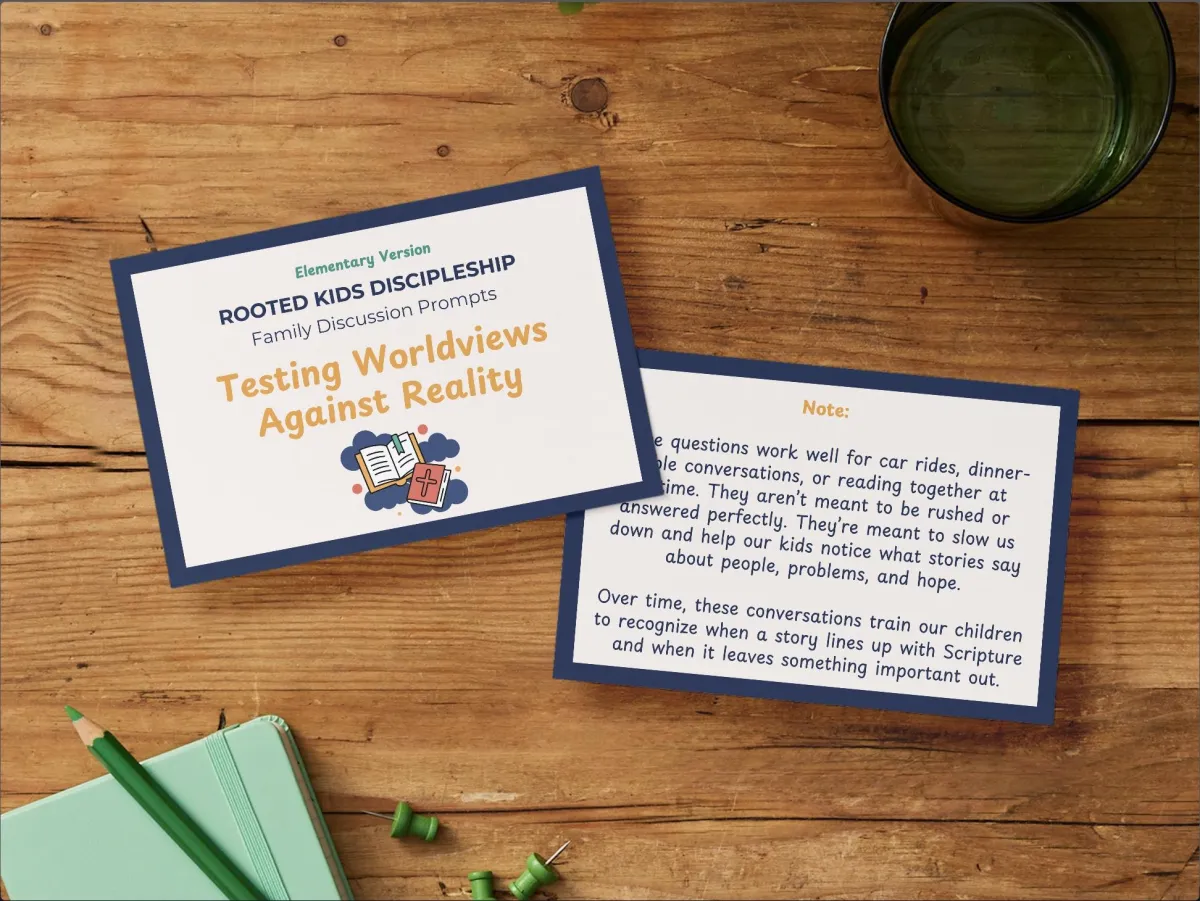
Simple, story-based questions to help elementary children notice what books, movies, and shows are teaching them about people, problems, and hope. Designed to spark gentle conversations that build discernment without overcomplicating things.
Worldview Conversation Guides
(The Four Questions)
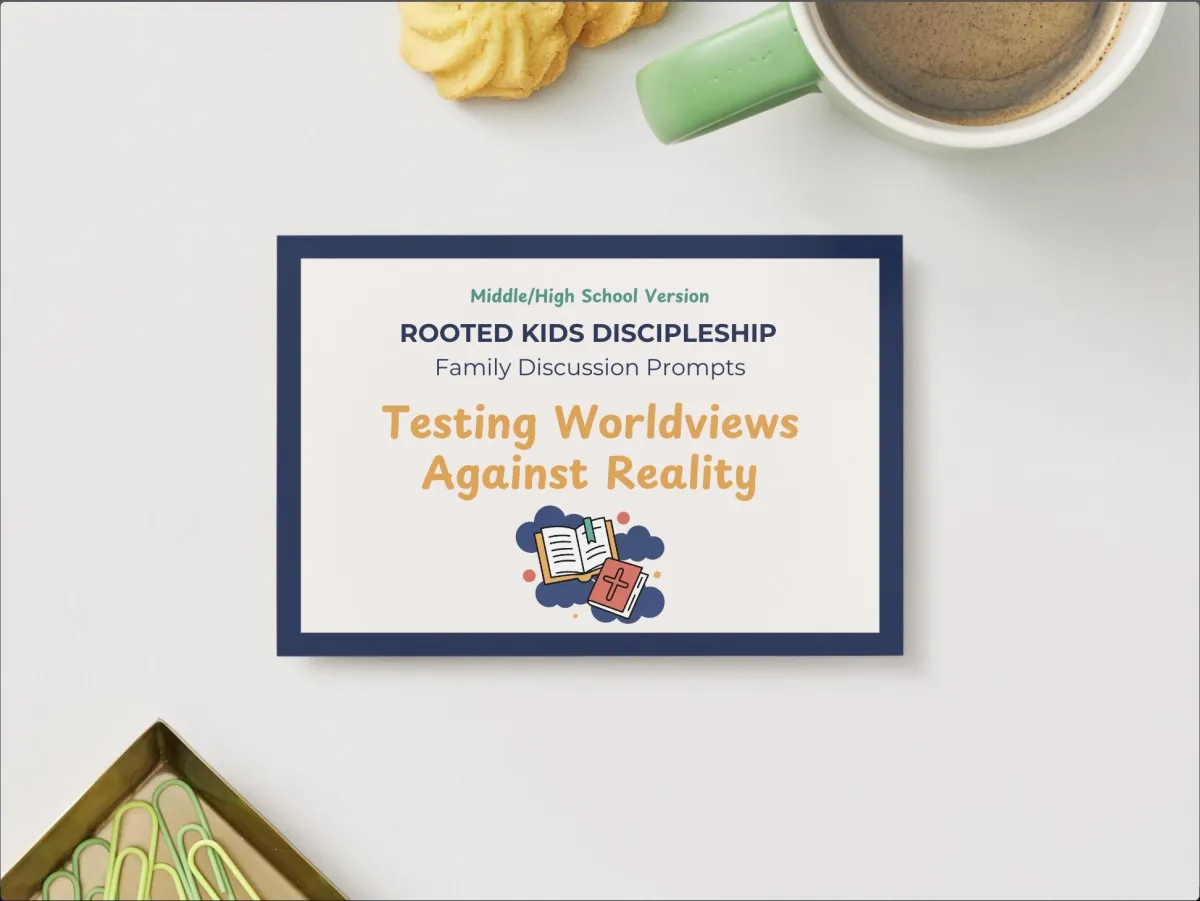
Guided questions that help middle/high school kids and teens evaluate the messages behind stories, music, movies, and school lessons. These prompts encourage deeper thinking about truth, worldview, and whether an explanation actually holds up to real life and Scripture.
Core Skills Children Learn
Discernment
Learning to notice what stories are teaching beneath the surface, not just what they say out loud.
Biblical Comparision
Practicing how to place cultural messages alongside Scripture to see where they align, differ, or fall short.
Critical Thinking
Asking thoughtful questions about ideas, assumptions, and solutions instead of accepting them automatically.
Conversation & Listening
Building the habit of respectful, meaningful discussion within the family.
Hope Evaluation
Learning to recognize where a story places its hope, and whether that hope can actually hold up over time.
Younger children learn to notice. Older children learn to evaluate.

Raising Kids Rooted in Scripture, Truth, and Discernment

